Contact : +254 725 877 146

Built for Speed, Silently Facing Extinction: International Cheetah Day 2025

Built for Speed, Silently Facing Extinction: International Cheetah Day 2025
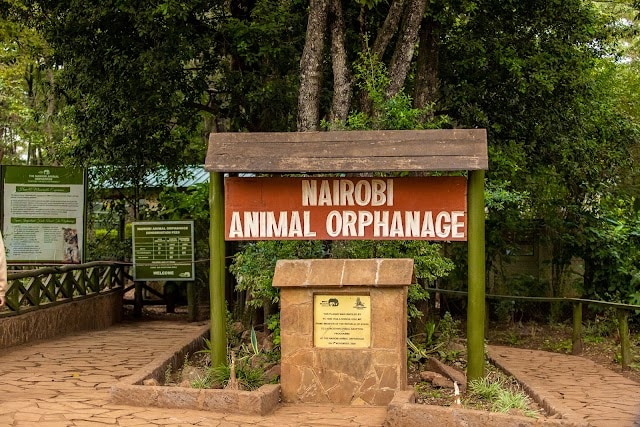
I count myself lucky to have interacted with the Cheetahs both in the wild and in captivity. During my attachment in 2016 under Nairobi Animal Orphanage at the Kenya Wildlife Headquarters I nursed cheetah cubs for one month in the animal nursery. For two months I was a care giver of Robert, an adult cheetah that was loved by many of the facility’s visitors.In the year 2019, I visited Ollaro conservancy in the Greater Masai Mara ecosystem and I was lucky to spot mother cheetah and her cubs only for them to vanish into the grass before my camera could focus
International Cheetah Day is one of my favourite Days whenever I look at my conservation calender. With less than 7,500 individuals left December 4th is a day to celebrate the Cheetah. It was in the year 2010, when Dr. Laurie Marker designated December 4th as International Cheetah Day, Khayam’s birthday. This day was initiated as an annual celebration in remembrance of a cheetah cub named Khayam, that she raised at Wildlife Safari in Winston, Oregon. Dr. Marker used Khayam to determine whether or not captive Cheetahs can be taught to hunt and live in the wild on their own after being in captivity during her trip to Namibia. The experiment was a success and later on Dr. Marker and Khayam returned to Winston, Oregon.
Know Your Cheetahs
A tall slender cat with even spaced, circular spots with black stripes from front of eye to corner of the mouth. They live in open country from desert to dry savannah, including open bush country, sometimes found at the edge of the moist savannah. Their diet is small to medium –sized mammals, the main animals being Thomsons gazelle and Impalas. When they reach maturity the males weigh 50kg while females weigh 40 kg. Males sexually mature at 14 months while females sexually mature at 9-10 months. Gestation period is normally 90 days with a litter size of 2-8 cubs.
Cheetahs have distinctive black tear marks that connect from the inside corner of each eye to the mouth. The tear marks are believed to serve as an antiglare device for day time hunting. The cheetah voice is amazing, they have a high pitched, bird-like contact call. They purr loudly when contented and growl, spit and hiss whenever they feel threatened or angry. Cheetah’s are the only big cats that do not roar.
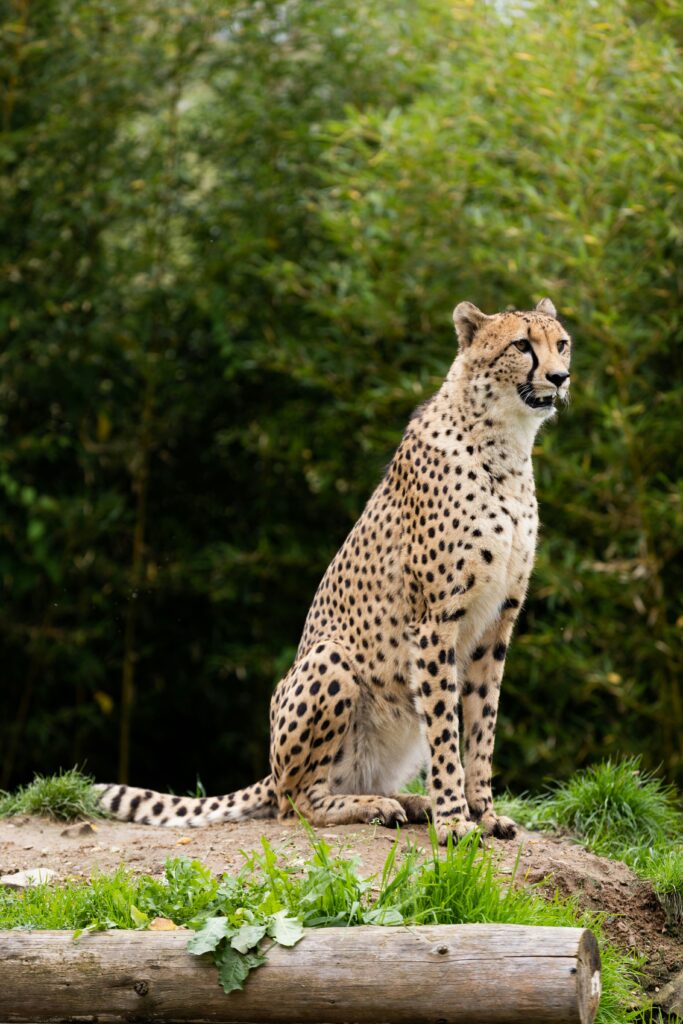
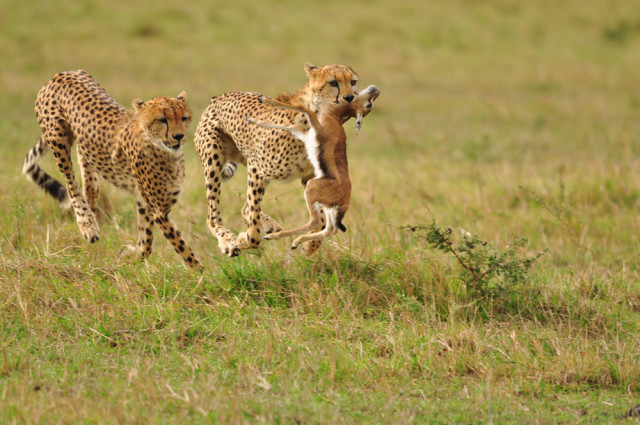
Cheetahs usually hunt during daylight, preferably early morning or early evening but they are also active on moonlit nights. Cheetahs single out a particular animal and then stalk it, moving within 45-55m of it before the chase begins. They pursue their prey for a few hundred meters reaching speeds of up to 122kph. At this point they must either catch their prey or stop as their body temperature rises to a critical level during a long sprint. Its prey is often tripped and hooked with the sharp dewclaw. The final blow is suffocation, caused by biting the prey’s jugular vein.
Ecological Role
Without predators like the cheetah, the savanna ecosystem would be very different and the current ecological trend toward desertification would be accelerated. Cheetahs are one of the most successful hunters on the savanna but their kills are very often stolen by larger carnivores or predators that hunt in groups. Predators play an important role in any ecosystem. They keep prey species healthy by killing the weak and old individuals. They also act as a population check which helps plants-life by preventing overgrazing.
Threats to Cheetah conservation
The key threats to survival of cheetahs are:
- Human-wildlife conflict – In Africa, about 90% of cheetahs live outside of protected areas on private farmlands and thus they frequently come into conflict with people.When a predator threatens a farmer’s livestock, they also threaten the farmer’s livelihood. Farmers act quickly to protect their resources, often trapping or shooting the cheetah. Because cheetahs hunt more during the day, they are seen more often than the nocturnal predators which contributes to a higher rate of persecution on the cheetah.
- Habitat loss – Cheetahs require vast expanses of land with suitable prey, water, and cover sources to survive. As wild lands are destroyed and fragmented by the human expansion occurring all over the world, the cheetah’s available habitat is also destroyed. Available habitat is fragmented, and degraded reducing the number of animals an area can support. Numerous landscapes across Africa that could once support thousands of cheetahs now struggle to support just a handful.
- Illegal wildlife trade and poaching– Unfortunately, cheetah cubs are taken from Africa and smuggled into the exotic pet trade because in some parts of the world cheetahs are still viewed as status symbols. Though cheetah ownership and exotic pet ownership has been outlawed in many countries, there is still a high demand for cheetahs as pets. More than 50% of cheetah cubs are illegally captured from the wild for trade.
Ways to celebrate International Cheetah Day.
1.Create awareness about Cheetahs
- Organize or attend a variety of functions held on International Cheetah Day at various local organizations or Zoos.
- Read books about cheetahs to children, whether buying them or borrowing them from the local library.
- Watch a cheetah documentary
2. Help different Organizations to conserve Cheetahs.
- Donate to various organizations involved in cheetah conservation i.e Cheetah Conservation Fund to support its initiative .
3. Spread the Word About International Cheetah Day by organizing games different like football or running for Cheetahs. This is effective when the community living around cheetahs get involved in conservation.
4.Become a cheetah ambassador
- Educate your family, friends and the larger community about the threats to cheetah extinction and encourage them to contribute to the conservation of cheetahs.
5.Visit a Zoo or Park
- Visit a wildlife conservation facility where you could see cheetahs, if you are in Kenya Nairobi Animal Orphanage is the ideal place for you to encounter cheetahs at a close range.
Did you know?
There are five extant sub species of cheetahs in the world. They include the East African (Acinonyx jubatus raineyi) , the Southern or Namibian cheetah , (Acinonyx jubatus jubatus) , the Sudan cheetah (Acinonyx jubatus soemmeringii) ,the Northwest African cheetah (Acinonyx jubatus hecki) and the Asiatic cheetah (Acinonyx jubatus venaticus)
This International Cheetah Day, let’s channel our awe for Earth’s fastest land mammal into action, ensuring it does not silently sprint into extinction